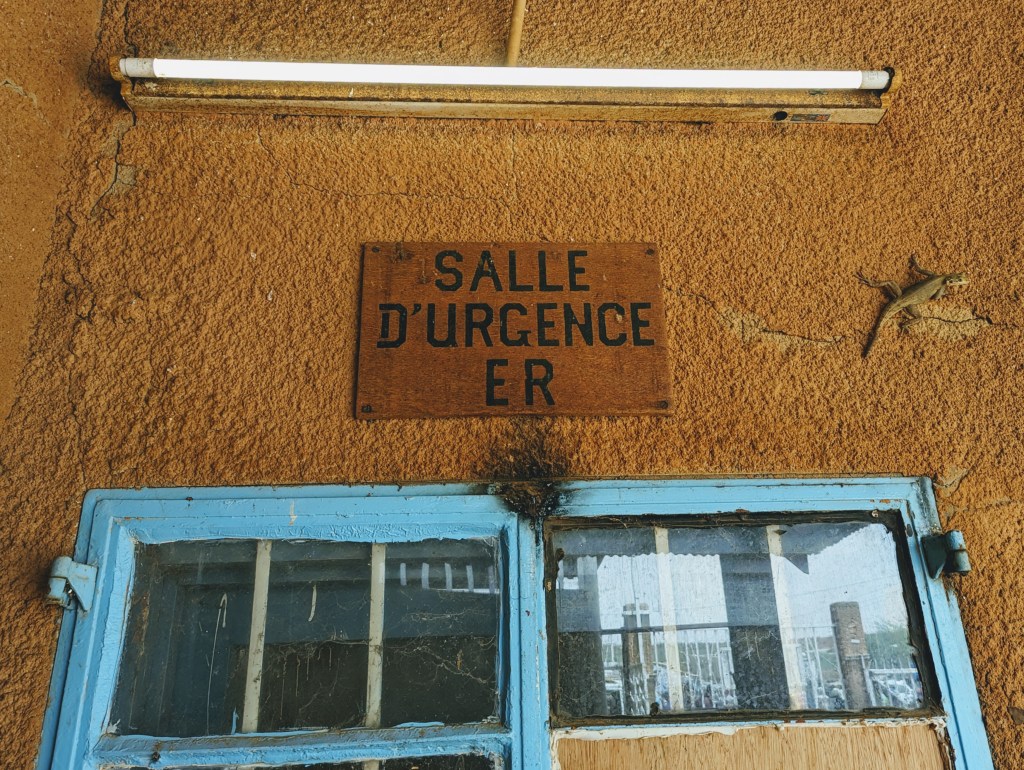
The older nurse yelled at the crowd of people, who came flooding into la salle d’urgence (the SU, considered our “emergency room”) following the new trauma victims. The nurse ordered the unwanted visitors to leave as their numbers surpassed the SU’s limited capacity. In a state of frenzy, she banged one of the wanky swinging doors shut and flipped the lock with her sandal. It was the day after Eid al-Fitr (the end of Ramadan) and as anticipated, the SU received a surge of people. Lingering visitors were taking out their phones to take pictures of a young man whose arm was almost severed from its shoulder due a possible attack or brawl from another town. He was barely conscious, but the police escort was able to provide some history. (Miraculously, the surgeons were able to save his arm.) Besides the usual roadside accidents and complaints of general malaise, we had some other interesting cases that evening that necessitated special attention, like an adolescent who was brought in for a questionable intoxication. The nurse told me that this was a normal day for the SU after the holidays. There had been worse days when she was working alone and the SU’s bed capacity and waiting area had reached its maximum. I was relieved that she was there as I just started my rotation in the SU and now understood why she was aggressively directing traffic and putting out fires.
In the SU, nurses will sit at the nurse station and knit until the door swings open with new arrivals. They usually work in pairs. Sometimes patients come walking in carried by a family member, or sometimes they are rolled in by a wheelchair or “stretcher” from a car or ambulance. We receive many referrals from other health posts in different towns. The SU receives, on average, twenty patients per day, and for busier days, over thirty patients. The SU has seen it all: from peritonitis (usually due to typhoid) to asthma to pediatric heart failure to falls (all kinds, even falls into wells) to burns to gastroenteritis and strokes. The SU nurses are trained to assess, give immediate medical relief, and write patient histories, which are usually translated from Hausa into French. Immediately following, they insert IVs and draw labs. Once the patient is triaged, the nurse calls the medical or surgical resident on-call. Being in a low-resource setting, treatment and medication are usually straightforward as the protocols are. Challenges appear when patient histories seem unclear or too generalized, especially if they describe their problem as “hurting all over,” or if their histories change upon the doctor’s examination. The other half of the time, nurses redirect patients to go to the outpatient clinic if it is not urgent or end up explaining to patients that they have to pay for the 7,500 CFA (about $12 US) consultation because the “medicine” is not free. At this point, some people decide to leave and seek treatment elsewhere. Unfortunately, we often see them come back again.
The nurses’ scope of practice is widely varied here as they deal with things even beyond medical complaints, such as the socioeconomic grievances of the patient’s household. It is no easy task, especially when most of the local nurses here know exactly where these people are coming from. My hat (or nursing cap) goes off to them.
In this 5-bed capacity room, expect that anything can happen (and it probably will). Here are three short lessons learned from my time in the SU:
1. People come when they are really, really sick, especially when traditional medicine has worsened their condition.
2. A lot of roadside trauma comes through our doors, most of them attributed to motorcycle accidents.
3. Not everyone who comes in with a fever or general malaise has malaria (but most of them do).

 Day of Small Things
Leave a comment